

Appeals signed, sealed, and delivered with greater return and less cost.
October 7, 2026
If you’re in the camp that believes direct mail is dead, “Have we got news for you.” Current research shows that direct mail appeals average between a 3 – 9% response rate, vs. email which is less than 1%. And if your appeal mailing is personalized and sent to an engaged donor, vs. a mass mailing, the average gift is up to four times higher.
Plus, you can see a nearly a 40% increase in donations if you are mailing appeals three times per year along with cross-channel promotion. So how do you incorporate direct mail into your communication strategy or perhaps freshen up your current mailings? Start with the post office.
Show us the money.
One of the key contributors to realizing higher returns can be found through the use of Nonprofit USPS Marketing Mail.
Through this mailing permit, the US Postal service “offers discounted bulk postage rates for eligible organizations, cutting mailing expenses significantly compared to commercial rates.”
First class postage today is $.82 — that’s almost a dollar. But your organization, ministry, or church can save over $.75 per piece using Nonprofit USPS Marketing Mail.
What’s the fine print?
Let’s look now at what’s involved in using nonprofit marketing mail.
First, you need to make sure you have established all the basic elements and tools you’ll need to take advantage of nonprofit USPS Marketing Mail. <
To be eligible . . .
- 501(c)3 tax exemption
- Completion and submission of the PS Form 3624 [Download provided on this Consider This Blog page]
- Mailing fundraising appeals, newsletters, event invitations, and educational materials without commercial advertising or non-affiliated business
- Over 200 unique recipients receiving the same mailing
- A licensed direct mail service provider to process your mailing
- Mailing list that has been vetted through the National Change of Address [NCOA] postal address verification system
Applying for Nonprofit USPS Marketing Mail
If you haven’t applied with the US Postal Service already, you will need to complete and submit PS Form 3624, the application to mail at Nonprofit USPS Marketing Mail prices. This form is used by the USPS to formally check your nonprofit status and eligibility. So, if you aren’t a 501(c)3 organization, you won’t be qualified. We’ve provided a link to the download of this form below on this blog’s webpage for your convenience.
You can also search for the form on the USPS website. Once you’ve been approved, you will be given the information you will need to provide a commercial direct mail handling service, who can work as your agent, in preparing your mail so that you can use nonprofit bulk rates.
Preparing your list for direct mail usage will require a structured list of contacts you’ve segmented from your relationship management system or CRM. Remember, you do need to have 200 or more recipients on your direct mail list to qualify for nonprofit bulk mail rates. And the contents of the mail pieces in a single mailing must be identical. The only variation allowed is personalization such as name and engagement and the current address of the recipient.
When you have segmented your list, you will need to export your list in a format that can be used by your direct mail service provider, which is generally a comma separated values (CSV) file. If you are only using an Excel spreadsheet, you will need to have each recipient in a single row and each field separated. Your direct mail agent can assist you if you’ve never created a direct mail list for processing.
National Change of Address [NCOA]
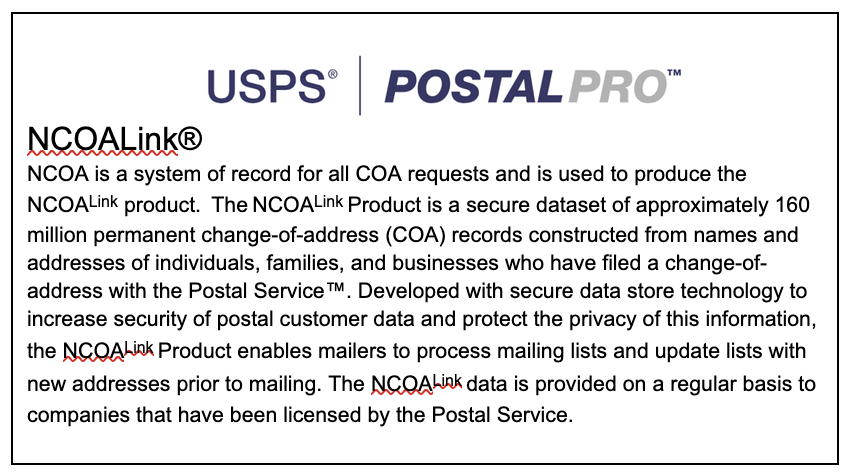
You are next required to check your mailing list through NCOA to make sure it is current. NCOA, or national change of address, is the USPS database used to update mailing addresses. The system tracks move data for the individuals, families, and businesses that have filed a change of address with the postal service.
If you do have a contemporary CRM, relationship management system, you may be able to conduct the NCOA processing within your own system. If not, your mail service provider can run the processing on your list and update the addresses for both those who have moved and drop those on your list who no longer have a new address. They will also provide you with the changes to your list so you can update your in-house CRM.
Once your list has been NCOA processed, either your CRM or your direct mail service provider need to create the NCOA processing acknowledgement form, which will need to accompany your direct mailing when it’s delivered to the post office.
The US Postal Service requires the NCOA process for verification processing, which helps diminish the likelihood of mail that can’t be delivered — that’s one of the reasons they charge you less for postage.
Put a stamp on it.
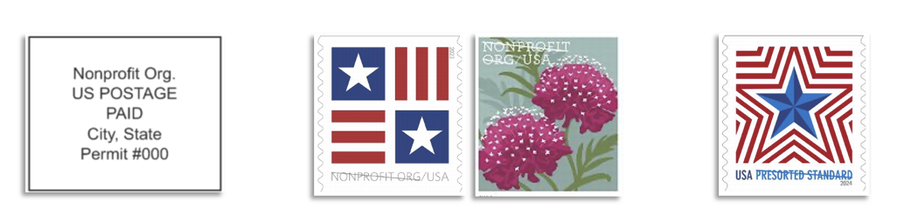
If your application has been approved and you’ve received a Permit, you can use a number of different postage formats for your direct mailing. An indicia can be designed on the artwork you’ll be providing and printed on your mailer or your service provider can print it during addressing. We’ve demonstrated here the basic content that needs to be presented. A side note that non-profit is one word, not hyphenated, and this sample is correct.
Your direct mail service provider can use your permit number or can use their own ghost permit if you’ve been approved for nonprofit bulk mailings and imprinted on your envelope or self-mailer when they are addressing it.
For a few cents more, you can have a nonprofit stamp applied to your piece, which we highly recommend, especially if the mailing is an invitation or holiday greeting. There are generic stamps and also nonprofit stamps with seasonal designs. The use of actual stamps helps your mailer look more appealing and less like junk mail.
If you don’t have 200 recipients or need your mailing to arrive sooner than through nonprofit bulk, consult your direct mail service provider on sending your mailing using First Class Presorted mail. It will still save you considerable postage costs but is faster.
Don’t do it yourself.
Another myth about nonprofit direct mail is that it’s cheaper to process the mailing inhouse instead of using a direct mail service provider. Again, nope. A direct mail service will generally charge a few cents per piece they address, apply postage, sort, and deliver to the post office. For example: If you’re mailing 500 appeal letters, the cost for a direct mail service to process your Nonprofit USPS Marketing Mail would be around $15 . . . for an in-house project that could take staff and volunteers days.
Consider These Cahoots Courses
Receive Direct Attention — Address Yourself to Donors With Direct Mail
Your Marketing Strategy — Planning With Reach and Frequency
Increasing Your Appeal — Seven Steps to Solicit Support
Providing all the details about planning, creatively producing, and processing your nonprofit direct mail.